Comments closed
Category: Politics & Activism
I’ve mentioned my colleague Jack Bradigan Spula before. He writes the wonderful blog The Rochester Dissident.
I think the thing I like most about Jack is that he sees an entirely different side our of city from what most people see. Jack rides his bike everywhere, and his years on two wheels have caused his eye for detail to strengthen. Reading Jack’s blog is always revealing. He forces me to think about the world around me in ways that I often forget in my daily life.
For example, check out today’s post on a new college development project.
Comments closedOn May 1, I had the pleasure of speaking at Immigrant Rights Day rally in Rochester. If you’re interested, here’s what I had to say:
Buenos tardes. Mi nombre es Jason Crane. Soy un organizador para al sindicato UNITE HERE. UNITE HERE representa a trabajadores en las industrias siguientes: tejidos, lavanderÃas industriales, hoteles, casinos, servicio de alimento, aeropuertos y restaurantes. Mi sindicato cree que ninguna persona es ilegal. Cada trabajador tiene derechos legales, derechos civiles, y derechos de trabajo. Por favor perdóneme, pero el resto de este discurso es en inglés.
Good afternoon. My name is Jason Crane. I’m an organizer with UNITE HERE. UNITE HERE represents workers in textiles, industrial laundries, hotels, casinos, food service, airports and restaurants. My union believes that no person is illegal. We believe that all workers have legal rights, civil rights, and labor rights.
UNITE HERE supports the broadest possible legalization program for the 11-12 million currently undocumented workers. They’re here, they’re working, they’re contributing to our country. They should become legal permanent residents and then be able to earn their way to citizenship.
UNITE HERE does not support Bush’s guest worker program. However, we recognize that there’s going to be a future flow of immigrant workers. That’s why we support an immigrant worker visa with the following features:
- The visa must allow an immigrant worker to petition on his or her own for permanent residence.
- The new worker can’t be tied to an employer — there must be job portability. If you come to this country and go to work for a boss who treats you badly, you should be able to leave and go to work for somebody better.
- Immigrant workers must have the same legal, labor and civil rights protections that domestic workers have. They’re American workers, not second-class workers.
UNITE HERE supports family reunification. The government backlog is so huge right now that many workers with legal residence have to wait 10-15 years or longer for their spouses and children to get family visas. We want that backlog cleared up so that these families can be reunited.
Right next to this building is the Crowne Plaza Hotel, where the workers have been fighting for almost a year to get management to respect their right to choose whether or not they form a union. Many of these workers are immigrants from places like the Dominican Republic, Haiti, and Vietnam. They came here to find a better life for themselves and their families. At the Crowne Plaza, many of these workers make poverty-level wages, and many can’t afford health care. Is this the promise of America?
UNITE HERE thinks we can do better. We’re committed to helping workers in our industries create power for themselves so they can have respect on the job, so they can take care of their families, and so that life, liberty and the pursuit of happiness are more than pretty words.
Most people have forgotten why May 1 is an important day in the lives of workers. On May 1, 1886, close to 300,000 workers nationwide, including more than 40,000 in Chicago, took part in demonstrations for the eight-hour day. On May 4, workers rallied at Haymarket Square in Chicago to protest police brutality against striking workers on the South Side. As the last speaker finished his remarks, police marched in and demanded an end to the gathering. Then an unknown assailant threw a bomb into the crowd, killing and wounding several police officers and workers. Police arrested eight anarchists on charges of conspiracy to commit murder. All eight were found guilty and four were executed: Albert Parsons, August Spies, Adolf Fischer, and George Engel. The latter three were German immigrants.
The trial is often referred to by scholars as one of the most serious miscarriages of justice in United States history. Most people now believe that Pinkerton agents provoked the incident. In HYPERLINK “http://en.wikipedia.org/wiki/1893” \o “1893” 1893, Illinois Governor HYPERLINK “http://en.wikipedia.org/wiki/John_Peter_Altgeld” \o “John Peter Altgeld” John Peter Altgeld concluded that all eight defendants were innocent and signed pardons for those still alive.
As we stand here on State Street in front of the seat of government and next to the site of ongoing labor struggle, let’s remember the millions of immigrants who built this country. My union, UNITE HERE, pledges to fight for the rights of those who are here now and those yet to come. Thank you.
Comments closedIf you’ve ever seen a press conference by Steve Jobs or George Bush…
Comments closedAnd you can enjoy it here.
Comments closedYou can find out more about the September Fund at septemberfund.org.
Comments closedThis is from the always provocative sports writer and cultural commentator Dave Zirin. I don’t see it on his Web site, which is at EdgeOfSports.com. If it gets posted there, I’ll take this down and provide a link. In the meantime, Dave’s words are worth reading:
Comments closedBrother of the Fist: The Passing of Peter Norman By Dave Zirin
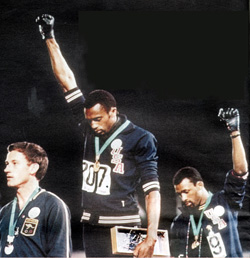
Almost four decades later, the image can still make hairs rise on unsuspecting necks. It’s 1968, and 200 meter gold medalist Tommie Smith stands next to bronze winner John Carlos, their raised black gloved fists smashing the sky on the medal stand in Mexico City. They were Trojan Horses of Rage — bringing the Black
revolution into that citadel of propriety and hypocrisy: the Olympic games.When people see that image, their eyes are drawn like magnets toward Smith and Carlos, standing in black socks, their heads bowed in controlled concentration.
Less noticed is the silver medalist. He is hardly mentioned in official retrospectives, and people assume him to be a Forrest Gump-type figure, just another of those unwitting witnesses to history who always end up in the back of famous frames. Only the perceptive notice that this seemingly anonymous individual is wearing a rather large button emblazoned with the letters O-P-H-R, standing for the Olympic Project for Human Rights.
Only those who see the film footage notice that he never throws a furtive glance back at fellow medal winners as they raise their fists. He never registers surprise or alarm. At a moment that epitomized the electric shock of rebellion, his gaze is cool, implacable, his back ramrod straight, a fellow soldier proud to stand with his brothers.
Only those who go beyond official history will learn about the true motivations of all three of these men. They wanted the apartheid countries of South African
and Rhodesia to be disallowed from the Olympics. They wanted more coaches of African descent. They wanted the world to know that their success did not mean
racism was now a relic of history. The silver medalist with the white skin stood with Smith and Carlos on every question and it was agreed before the race, that
if the three, as expected, were the ones on the dais, they would stand together: three young anti-racists standing together in struggle.That silver medalist with the nerves of steel and thirst for justice was Australian runner Peter Norman. Norman died of a heart attack last week at the age of
64 and Monday was put to rest.Two people who knew the depth and conviction of Norman’s solidarity were the two who acted as lead pallbearers at his funeral: Tommie Smith and John
Carlos. Over the years the three men had stayed connected, welded together by history and the firestorm they all faced when the cameras were turned
off.The backlash endured by Smith and Carlos is well documented. Less known are Norman’s own travails. He was a pariah in the Australian Olympic world, despite
being a five-time national champion in the 200 meters. He desired to coach the highest levels, yet worked as a Physical Education teacher, the victim of a down
under blacklist.As John Carlos said, “At least me and Tommie had each other when we came home. When Peter went home, he had to deal with a nation by himself. He never wavered, never denied that he was up there with us for a purpose and he never said ‘I’m sorry’ for his involvement. That’s indicative of who the man was.” ”
When the 2000 Olympics came to Sydney, Norman was outrageously outcast from the festivities, still the invisible man. In a conversation at that time with
sportswriter Mike Wise, Norman was absent of bitterness and wore his ostracism as proudly as that solidarity button from 1968. “I did the only thing I believed was right,” he said to Wise. “I asked what they wanted me to do to help. I couldn’t see why a black man wasn’t allowed to drink out of the same water fountain or sit in the same bus or go to the same schools as a white guy. That was just social injustice that I couldn’t do anything about from where I was, but I certainly abhorred it.”Norman never strayed from a life of humility. When a sculpture was unveiled of Smith and Carlos last year in California, Norman was left off, the silver medal
platform purposely vacant so others could stand in his place. Smith and Carlos protested it, feeling it fed the false idea of Norman as political bystander. But Norman himself who traveled from Australia to California for the unveiling said, “I love that idea. Anybody can get up there and stand up for something they believe in. I guess that just about says it all.”Norman didn’t define himself by self-promotion, book deals, or the lecture circuit — only by the quiet pride that he was a part of a movement much bigger
than himself. By happily surrendering his personal glory to the greater good, Norman earned the love and respect of his peers.As Carlos said about sudden passing of the man his children called Uncle Pete, “Peter was a piece of my life. When I got the call, it knocked the wind out of
me. I was his brother. He was my brother. That’s all you have to know.”Dave Zirin is the author of “‘What’s My Name Fool?’: Sports and Resistance in the United States” (Haymarket Books) You can receive his column Edge of Sports, every week by e-mailing edgeofsports-subscribe@zirin.com. Contact him at dave@edgeofsports.com.
I mentioned before that I’m now the leader of the 24th Legislative District (LD) committee of the Monroe County Democratic Party. Three LDs — 21, 23 and 24 — work together as the East Side Democrats. As of today, we have a new Web site at EastSideDems.com. Give it a look and let me know what you think.
Comments closedAs of Friday at 2 p.m., this was my plan for the weekend:
- Have dinner with my family on Friday evening
- Take Bernie to the Rhinos playoff game
- Spend a lazy Saturday with Jen and the boys
- Announce a game for the vintage base ball playoffs at Genesee Country Village on Sunday
And then, at a few minutes after 2 p.m., I got a call from the HQ of my union in New York City, asking me to hop on a plane and fly to New Jersey to lead a campaign for five days. So here I am, ensconced in a hotel room, glued to my cell phone and my e-mail account as I work to coordinate a team of seven people for an event early next week.
I cannot tell a lie: It’s kinda fun. I work for a union local, rather than the HQ, so I don’t have to travel too far, with the exception of the occasional trip to one of the cities upstate. That’s a nice arrangement, because I’m home with my family a fair amount. But it’s fun to get out of town and help some workers fight for what they deserve. It’s exciting to hit the ground running and to try to pull off a big event with a short amount of time. And it’s gratifying to know that the reason I do all this is so some folks are better able to defend themselves against a ravenous corporation which is trying to steal their benefits.
Comments closedMaybe you should sit down for this one.
On Wednesday night, I was elected as leader of the Democratic Committee for the 24th Legislative District here in Monroe County, NY. Why should that be a shock? Because I was previously chair of the Green Party in this same county, a party that exists not only in support of progressive causes, but in opposition to what is often called the two-party duopoly of American politics. So the question is: Have I sold out?
To some, the answer will be an unequivocal “yes!” I ran for City Council and got more votes than any independent candidate has received. I did this on the Green line in a district that’s home to the president of City Council and one of the most respected Dems in the county. I got creamed, but I received more than 30% of the vote in the LD where I now serve as leader.
But here’s the deal: It’s not realistically possible to win in Rochester as a Green. And at the state and national level, it’s the Democrats who can most easily stand as the progressive party. They don’t often do that now, but they have a ready-made structure for creating change. If I’m going to spend some amount of the time taking part in politics — time that could otherwise be spent at home or anywhere else — then I want the fastest route to effective action. That is the Democratic Party. I decided a few years ago to set aside my dreams of ideological purity and focus on making people’s lives better. That’s why I do the job I do. Unions may not be perfect, but they’re a lot better than letting the market decide whether folks should have a living wage, health care and a pension. Similarly, the Dems aren’t perfect, but it’s a lot easier to create change through that structure than to first have to build an entire party from the ground up, and then start solving problems.
So here I am, on the left end of the Democratic Party, trying to remind folks that what’s considered “left” in our media discourse is actually at the center of the American electorate. Who doesn’t believe in health care for all, good educations for our kids, jobs that create middle class families, and dignity in retirement, to name just a few ideas? These are basic American values, and I’m going to do my part locally to make sure that these are the values championed by this party.
It’s never easy to make choices like this one, but I’m confident that working to move the Democrats forward is the surest path to the change I want to create.
One Comment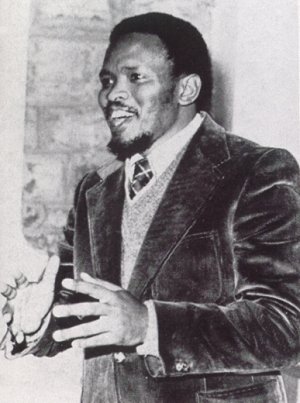
September 12, 1977: STEVEN BIKO IS KILLED
Steven Biko, leader of South Africa’s “Black Consciousness Movement,” dies of severe head trauma on the stone floor of a prison cell in Pretoria. Six days earlier, he had suffered a major blow to his skull during a police interrogation in Port Elizabeth. Instead of receiving medical attention, he was chained spread-eagled to a window grill for 24 hours. On September 11, he was dumped, naked and shackled, on the floor of a police vehicle and driven 740 miles to Pretoria Central Prison. He died the next day. In announcing his death, South African authorities claimed Biko died after refusing food and water for a week in a hunger strike.
Steven Bantu Biko, born in 1946, was the most influential anti-apartheid leader of the 1970s. As a medical student in 1968, he founded the all-black South African Students’ Organization with the aim of overcoming the “psychological oppression of blacks by whites.” Similar to the “Black Power” movement in the United States, Biko’s Black Consciousness Movement stressed black identity, self-esteem, and self-reliance. In the 1970s, Black Consciousness spread from the university communities to black communities throughout South Africa.
In 1972, Biko helped organize the Black People’s Convention, and in the next year he was banned from politics by South Africa’s white-minority government. As a “banned person,” he was forbidden by law from speaking in public or being quoted, leaving the area around King William’s Town, and being in the company of more than one person at a time. However, he continued to oppose apartheid covertly and was arrested four times during the next few years and held without trial for months at a time.
On August 18, 1977, he was arrested with another activist at a roadblock outside the small town of Grahamstown on his way to a political meeting in Cape Town. Taken to a prison in Port Elizabeth, he was stripped naked, manacled to a grate, and forced to lie on a filthy blanket for 18 days. On September 6, he was brought to the Sanlam Building, where police tortured prisoners as a means of interrogation. Five security officers took Biko into room 619 for interrogation. When he emerged, he was in a semiconscious state, having suffered severe head trauma that left him with multiple brain lesions. His injuries were left unattended, and he was chained, standing up, to a window grill for 24 hours.
On September 7, two government doctors finally examined Biko and found him hyperventilating, frothing at the mouth, and unable to speak or stand. They pronounced him fit to travel. On September 11, Biko, by then comatose, was thrown naked and chained into the back of a police truck, which drove 10 hours to Pretoria in the north. Dropped in a cell in Pretoria Central Prison, he succumbed to his injuries on September 12. He was 30 years old.
South African authorities attempted to cover-up the circumstances of Biko’s death, saying he starved himself on a hunger strike. They later claimed he died of kidney failure. Finally, when the findings of a postmortem were made public, they said he might have “hurt his head when he fell out of bed.” A judicial inquiry found no one responsible for his death and most of the policemen who interrogated Biko were promoted.Steven Biko was hailed as a martyr in the anti-apartheid struggle, and his death became an international rallying point against South Africa’s repressive government.
In November 1977, the United Nations voted a partial arms embargo against South Africa. U.N. resolutions calling for sweeping economic and military sanctions against South Africa were vetoed by the United States, Britain, and France.Apartheid was abolished in South Africa in 1991, and in 1994 Nelson Mandela was elected the country’s first black head of government. The following year, the Truth and Reconciliation Commission (TRC) was established to examine apartheid-era crimes. In exchange for full confessions of politically motivated crimes, the TRC promised amnesty for those who came forward.
In 1997, the five former security officers who interrogated Steven Biko on September 6, 1977, applied for amnesty from the TRC.One of the former officers, Daniel Siebert, said in his application to the TRC that he and two other officers ran Biko headfirst into a far wall of the interrogation room. Several of the officers spoke of Police Colonel Gideon Nieuwoudt striking Biko with a pipe. However, when the men testified before the TRC shortly before the 20th anniversary of Biko’s death, they claimed, in conflicting accounts, that Biko had injured himself in a scuffle. They said that the handcuffed Biko lunged at them during the interrogation and struck his own head against the wall. They said they didn’t provide immediate medical attention to him because they thought he was faking his injuries.In February 1999, the Truth and Reconciliation Commission denied the men amnesty, saying that the former officers’ version of Mr. Biko’s death was “so improbable and contradictory that it has to be rejected as false.” With the exception of murder, there is a 20-year limit on prosecution of criminal charges in South Africa.
It is unlikely that the former officers will face trial.
Biko has inspired many artists, including Peter Gabriel’s song “Biko” and the excellent film Cry Freedom by Richard Attenborough.
Comments closed
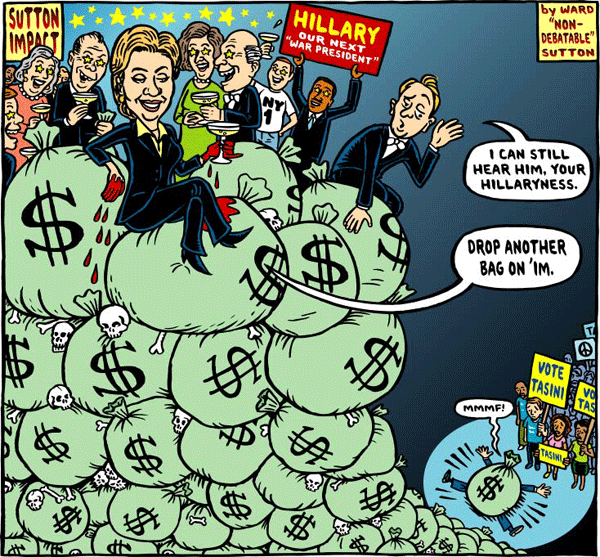
John Nichols of The Nation has this to say about supporting Jonathan Tasini in tomorrow’s primary in New York State.
Comments closed