Skip to content →

Category: Politics & Activism

On open source software and our electoral system

vote

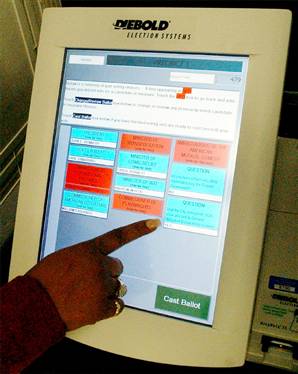
Dan Wallach wrote an interesting piece today titled Open Source vs. Disclosed Source Voting Systems, in which he discusses the need for open source software to be used in our voting machines if we’re to have any hope of electoral transparency. Here’s an excerpt:

Sometimes, working on voting seems like running on a treadmill. Old disagreements need to be argued again and again. As long as I’ve been speaking in public about voting, I’ve discussed the need for voting systems’ source code to be published, as in a book, to create transparency into how the systems operate. Or, put another way, trade secrecy is anathema to election transparency. We, the people, have an expectation that our election policies and procedures are open to scrutiny, and that critical scrutiny is essential to the exercise of our Democracy. (Cue the waving flags.)

And one more excerpt:

Voting systems, in this regard, are just like Microsoft Windows. We have to assume, since voting machines are widely dispersed around the country, that attackers will have the opportunity to tear them apart and extract the machine code. Therefore, it’s fair to argue that source disclosure, or the lack thereof, has no meaningful impact on the operational security of our electronic voting machines. They’re broken. They need to be repaired.

The entire article is worth your time.

Leave a Comment

Evangelism (the open source kind)

Software journalist Bruce Byfield has an interesting post today about free software evangelism and why he keeps his mouth shut at parties.

I tend to feel — and act — this way regarding most evangelism. It’s usually not fun to have political discussions at parties because people have so few facts at their command. Maybe it’s my personality, but I find it very hard to have “discussions” between entrenched positions where there is no hope of movement.

Leave a Comment

Constitutional scholar apparently needs to brush up on Constitution

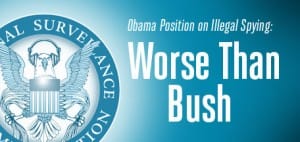
nsa_front_obama2

Look, I know the guy’s a centrist, OK? I know he’s not the Messiah. But I’m still quite disappointed:

In a stunning defense of President George W. Bush’s warrantless wiretapping program, President Barack Obama has broadened the government’s legal argument for immunizing his Administration and government agencies from lawsuits surrounding the National Security Agency’s eavesdropping efforts.

In fact, a close read of a government filing last Friday reveals that the Obama Administration has gone beyond any previous legal claims put forth by former President Bush.

Responding to a lawsuit filed by a civil liberties group, the Justice Department argued that the government was protected by “sovereign immunity” from lawsuits because of a little-noticed clause in the Patriot Act. The government’s legal filing can be read here (PDF).

For the first time, the Obama Administration’s brief contends that government agencies cannot be sued for wiretapping American citizens even if there was intentional violation of U.S. law. They maintain that the government can only be sued if the wiretaps involve “willful disclosure” — a higher legal bar.

The text above is from an article by Raw Story’s John Byrne.

I didn’t expect Obama to do the right thing on the war(s), or to be some great progressive leader. But I did expect him to at least break with the Bush administration when it came to respecting the basic tenets of the Constituion and U.S. law. Apparently that faith was misplaced. Sad.

By the way, if you want to help the Electronic Frontier Foundation do its good work in this and other cases, visit their Web site and toss them some money.

Leave a Comment

The Democrats’ debt to the people of New Orleans

Melissa Harris-Lacewell and James Perry co-authored this piece for The Nation. Here’s an excerpt:

When New Orleans flooded in August 2005, the Democratic Party was a shambles, locked out of the White House, the Senate and the House of Representatives. For nearly a decade the Democrats played defense against a Republican onslaught initiated by Newt Gingrich’s Contract With America. After September 11, Democrats had joined with Republicans in giving President Bush unprecedented executive authority, thereby helping to erode civil liberties at home and authorize ill-advised aggression overseas. In 2004 Democrats were keenly aware that a solid majority of Americans believed it was unpatriotic to protest the Iraq War. So instead of articulating a clear alternative to Bush’s militarism, they nominated John Kerry on the strength of his record as a solider. Even so, they found it impossible to outmaneuver the existing commander in chief.

In August 2005 the Democratic Party had no clear leader, no identifiable platform, no winning national coalition and little political courage.

Then the force of Hurricane Katrina devastated the inadequate levees surrounding New Orleans. Americans watched as the city flooded, the power went out, and food and water became scarce. They watched as emergency shelters became centers of disease, starvation, agony and death. The nation watched in horror, but no mass evacuation began and Air Force One did not land. As the crisis wore on, the public became increasingly confused by and angry about the lack of coordinated response to alleviate human suffering and evacuate trapped citizens. As the waters rose, President Bush’s approval sank.

Read the rest of the article.

Leave a Comment

Call for government response, in rhyme

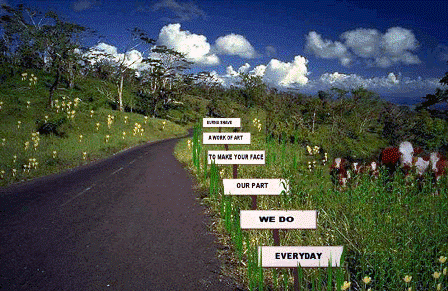
bheveryday_lrg
A classic Burma-Shave sign poem

From today’s Albany Times-Union:

Greenfield residents use touch of humor to push town for road repairs

By DENNIS YUSKO, Staff writer
First published: Tuesday, March 10, 2009

GREENFIELD — Denton Road residents have adopted an old advertising technique to protest the street’s poor condition.

Upset that the nearly 2-mile corridor straddling Greenfield and Saratoga Springs hasn’t been repaved in years, neighbors plugged campaign-style signs with balloons into nine bales of hay and planted them along the road.

In an echo of the old rhyming roadside ads for Burma-Shave shaving cream, the green placards form a jingle for passing motorists: “Try to avoid, The hazards here, And say out loud, Elections are near! A safe road, Is just a mirage, But we do have, A new town garage, Thank you Greenfield!”

Read the rest of the article at the TU site.

Leave a Comment

BOOK REVIEW: 187 Reasons Mexicanos Can’t Cross The Border

Poet, teacher, author and Chicano activist Juan Felipe Herrera has collected some of his most provocative and autobiographical writing in this volume. These “undocuments” chronicle Herrera’s travels in the U.S. and Mexico, and his relentless search for the soul and story of a people.

Herrera’s poetry is shouted with an upraised fist at one moment, intoned with a somber brow the next. He has no illusions, but his best work is powered by a grand vision of the past and the future.

Some of the work is helped by a knowledge of Spanish, which I don’t possess. Even so, I had no trouble being caught up in the sound and spirit of Herrera’s writing.

We need more documentary poetry like this to capture the real history of this country, and of the peoples and cultures within it.

Highly recommended.

Leave a Comment

POEM: Luxury Hotel

Luxury Hotel

Room after room after room with no stopping, no let-up.
How many in a year? Five thousand? Six thousand?
The human body can only take so much.
So many liftings of the mattress, so many bends of the knees.
Then there are the chemicals, the solvents, the cleaners.
Scrubbing with your face right down in the fumes,
breathing deeply from the exertion.
Cracked skin, aching muscles, arms like rubber.
You can’t even lift your baby girl for a kiss.
Other people’s pubic hair, other people’s vomit and blood.
One time there was a man hiding in the closet.
He put one finger to his lips and told you to be quiet,
but how could you be quiet when there was a man in the closet?
So you screamed and ran and they gave you half a day off.
Another time you begged and begged for shoes,
the kind with the special soles so you wouldn’t slip.
After days and weeks and months, they ordered them
on the very day your head hit the tile floor,
the same day they cornered you in the manager’s office
and nobody called for a doctor, the same day
you passed out waiting for the bus and a passerby
took you to the emergency room. A stranger had to do that.
There are seven Dominicans and three women from Jamaica
and five Senegalese and one Vietnamese lady in the laundry
with no English who keeps to herself in the mouth of the furnace.
Eight hours, ten hours, twelve hours if it’s busy.
Then it’s home to cook and do your own laundry and help
Javi and Lisa with their homework. Make the lunches
for the next day. Shrink into the bed and fall asleep
to the throbbing in your joints. The alarm at 4 a.m.
Then it’s room after room after room with no stopping, no let-up.
How many in a year? Five thousand? Six thousand?
The human body can only take so much.

One Comment

Book Review: Joe Sacco’s Palestine

Journalist and comic book artist Joe Sacco has been rightly praised for this intense account of his time in the Palestinian territories during the first Intifada. Sacco decided from the start to tell the Palestinian side of the story — not to aim for the false balance of much of modern journalism. His graphic novel is primarily a series of interviews with Palestinians, some arranged in advance and some on the spur of the moment.

If you enjoyed Art Spiegelman’s MAUS books, you’ll probably like Sacco’s work.

Highly recommended.

Leave a Comment

Book review: The United States Constitution: A Graphic Adaptation

This brilliant graphic novel tells the unvarnished story of the development and amendment of the U.S. Constitution. The book is no hagiography of the document or its authors. Hennessey and McConnell point out the flaws in the Constitution and its unfortunate application to restrict the rights of many Americans.

In total, though, this book, like the best history books, inspires both an appreciation for past events and a desire to improve conditions going forward. Hennessy and McConnell are to be commended for furthering the cause of Constitutional literacy. Get this for every middle- and high-school student you know, and get a copy for yourself, too.

Highly recommended.

Leave a Comment

Responding to the post-Katrina race war in New Orleans

The current issue of The Nation has a very disturbing report on white vigilantism in New Orleans after Katrina. Here’s a description along with a link to pressure the NoLa authorities to investigate these crimes:

A new report in The Nation[1] documents what many have claimed for years — for some Black New Orleanians the threat of being killed by White vigilantes in Katrina’s aftermath became a bigger threat than the storm itself.

After the storm, White vigilantes roamed Algiers Point shooting and, according to their own accounts, killing Black men at will — with no threat of a police response. For the last three years, the shootings and the police force’s role in them have been an open secret to many New Orleanians. To date, no one has been charged with a crime and law enforcement officials have refused to investigate.

The report is helpful, but given Lousiana’s horrible record on protecting its Black citizens, justice will only come if we demand it.

I’ve joined ColorOfChange in calling on Louisiana Governor Bobby Jindal, Louisiana’s Attorney General Buddy Caldwell, and the U.S. Department of Justice–to conduct a full investigation of these crimes and any police cover-up. Will you join me? It takes only a moment:

ColorOfChange.org

In the two weeks after Hurricane Katrina made landfall, the media created a climate of fear with trumped-up stories of Black lawlessness. Meanwhile, an armed group of White vigilantes took over the Algiers Point neighborhood in New Orleans and mercilessly hunted down Black people. “It was great!” said one vigilante. “It was like pheasant season in South Dakota. If it moved, you shot it.”

“The Nation’s” article tells the story of Donnell Herrington, Marcel Alexander, and Chris Collins–a group of friends who were attacked by shotgun-wielding White men as they entered Algiers Point on September
1, 2005. As they tried to escape, Herrington recalls, their attackers shouted, “Get him! Get that nigger!” He managed to get away. Alexander and Collins were told that they would be allowed to live on the condition
that they told other Black folks not to come to Algiers Point. Herrington, shot in the neck, barely survived.

And there’s the story of Henry Glover, who didn’t survive after being shot by an unknown assailant.[2] Glover’s brother flagged down a stranger for help, and the two men brought Glover to a police station. But instead of receiving aid, they were beaten by officers while Henry Glover bled to death in the back seat of the stranger’s car. A police officer drove off in the car soon afterward. Both Glover’s body and the car were found burnt to cinders a week later. It took DNA analysis to identify the body.

These are only a few of the stories of Black folks who were accosted in Algiers Point, and you can read more in The Nation. But unless you speak out, we may never learn the full extent of the violence. Journalists have encountered a wall of silence on the part of the authorities. The coroner had to be sued to turn over autopsy records. When he finally complied, the records were incomplete, with files on several suspicious deaths suddenly empty. The New Orleans police and the District Attorney repeatedly refused to talk to journalists about Algiers Point. And according to “The Nation” journalist A.C. Thompson, “the city has in nearly every case refused to investigate or prosecute people for assaults and murders committed in the wake of the storm.”

The Nation article is important, but it’s just a start. For more than three years now, these racist criminals have by their own admission gotten away with murder while officials in New Orleans have systematically evaded any kind of accountability. We have to demand it.

Please join us in calling on state and federal officials to investigate these brutal attacks and the conduct of Orleans Parish law enforcement agencies, and please ask your friends and family to do the same.

ColorOfChange.org

Thanks.

—-

1. “Katrina’s Hidden Race War,” The Nation, 12-18-2008

2. “Body of Evidence,” The Nation, 12-18-2008

Leave a Comment

Tasini to Paterson: Are you insane, Dave?


Labor writer and activist Jonathan Tasini

Jonathan Tasini has written a simple and compelling piece about NY Gov. David Paterson’s call for pension givebacks for state employees. Here’s the core of Tasini’s argument:

We could wipe out the budget deficit–or, certainly trim it down to something trivial–by raising taxes on the very wealthy and going back to a more progressive taxation system that we had in the 1970s. You know this: if the state replaced the existing rate structure (consisting of 5 brackets with rates ranging from 4.0 to 6.85%) with one consisting of 14 brackets with rates ranging from 2.0 to 15.0%, we could bring in $6-7 billion more, and perhaps as high as $11 billion.

Under this plan, 95 percent of the state’s taxpayers—95 percent of the people—would receive a tax cut. Like the proposals championed by President-elect Barack Obama, a more progressive taxation system would be easing the burden on the people who are the most at risk in our economically troubled times. The top one percent of taxpayers—whose average income is $2.685 million—would see their taxes go up about 5.4 percent. The four percent below that top one percent—those people whose average income is $326,000—would have their taxes rise 1.4 percent.In fact, the top five percent would have their dues burden slightly reduced because higher state taxes would lower their federal obligations.

Everyone else would realize a reduction in their taxes.

I highly recommend the rest of the article, too.

Leave a Comment