telling stories in our hotel room
keeping my game face on
my Superman fights a giant robot
John’s defeats a huge gorilla
Bernie’s Man of Steel takes on a fire monster
he’s tired so he forgets
sometimes his villain is a robot, too
I’m wearing a necklace made of Kryptonite
my powers are fading
keeping my game face on so they won’t notice
never expected this hotel room
never expected the hurricane
and yes, that’s a metaphor
what kind of kit do you pack for a storm of rejection?
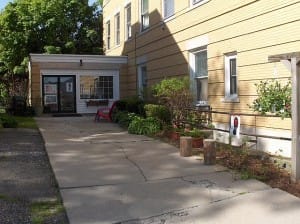
In Lenox, Massachusetts, on the picturesque corner
of Main and Housatonic Streets,
is a building with walls made of butter-yellow brick.
Looking up from the sidewalk to the second floor,
you can see the windows
through which my family used to see the world.
There was a drop ceiling in the den that gave way
under the weight of rainwater,
dousing my grandfather as he removed a sodden panel,
standing on a chair to get a better grip, while lightning
lit the windows of the pharmacy below.
There is a shop that sells art photos and gourmet chocolate
where the garage used to be. “Home again, home again
jiggety jig,” my grandmother would say
every time. Back when she used to ride in the car, back when
she used to have places to go. I am so old I can remember her
driving herself, the modern woman, cigarette
fashionably cradled by elegant fingers, red nails catching
the sun that elsewhere lit trees on our famous hills.
It was only in the leaving that I realized
the loss, only in the black-and-white grandeur of deco
living rooms and dancing at the Crystal Ballroom.
Now I would trade anything for that place,
that time, those days when a street corner was the world
and all I knew was safe and protected within it.
I had already asked you three times
you’d wisely declined
I was too young, too unproven
played the saxophone in a latin jazz band
you repaired houses for the poor
we each made barely enough to pay the rent
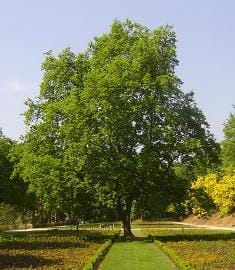
the fourth time was under an oak tree
at your mother’s house
you finally agreed, throwing caution
to the Pennsylvania wind
we were back East on a rare trip
to see our families, to display one another
that tree had been there for years and years
since the fields next to the dairy farm
were turned into a housing development
for upwardly mobile college professors
whose daughters spoke two languages
and traveled the world on the way to good lives
no one thought we’d last
they all said I was too young, too unproven
played the saxophone in a latin jazz band
couldn’t provide for you
all those beautiful 1950s sentiments
born of monochrome evenings with the Cleavers
but under that oak tree —
a sign of stability, of permanence —
you agreed to place a bet on the long shot
I held your hands as a stray leaf fell,
like your resistance, to rest
in the lush green grass behind the houses
after you said yes
we traveled north to my parents’ house
my mother gave me a wedding ring
that had been her grandmother’s
granting us her blessing
even though she doubted our future
the oak tree is gone now,
cut down by your mother
all these years I’d thought she hated what it represented
only found out this week that it was damaged
in an ice storm and had to be cut before it fell
so many things misunderstood
I may regret all this openness later, but for now a little missive here on the blog seems like the easiest way to answer all the questions that are coming up now and will be sure to come up soon. It’s getting more difficult to come up with plausible stories about what’s happening, so let’s try the truth.
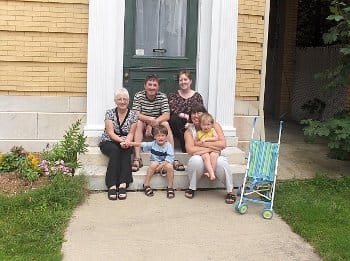
Tomorrow, Jen and Bernie and John (my wife and sons) are moving to State College, PA, to live with Jen’s mom. In a couple weeks, I’m moving into a one-bedroom basement apartment in Albany – even more downtown than I live now. We’re not sure how long the new arrangement will last.
Why is this happening? Primarily because we can’t afford to live together anymore. Jen’s been out of work for 18 months and counting, and I don’t make enough to pay the bills. In fact, my most recent job change was probably the straw that sent to camel to the poor house. I’m thrilled to have my current gig and to work in the world of bicycle advocacy, but it pays what non-profits often pay. We gambled that one of Jen’s many high-scoring civil-service tests would pull our fat out of the fire, but New York State has no budget and isn’t doing much hiring these days, so that gamble didn’t pay off. We lived on fumes (and with the help of our families) for a long time, but the tank is now empty.
This is a very dark time for the rebellion, and there’s no way to sugarcoat that. Our hope, though, is that something will turn up and allow us to get Jen and the boys back in time for school in the fall.
So now you know the rest of the story. Wish us luck, and keep us in your thoughts, along with the thousands and thousands of American families who are going through exactly the same thing.
A poem for my son John and his grandfather, after whom he was named. John Packard died in April 1996.
John, again (for my younger son and his grandfather)
he’ll never smell his grandpa’s pipe
never hear him laugh or make a corny joke
he’ll never feel the rumble of the BCS
as it plows up the rich earth for planting
he’ll never sit at the oval table
never pass a bowl of fresh-picked veggies
or watch his grandpa butter warm bread
he’ll never be tickled by a mustache
or smell the sweat on an old t-shirt
never be picked up in a wiry embrace
or put his cheek against rough stubble
but he’ll carry with him the joy in the land
and he’ll walk with solid steps on country lanes
he’ll laugh when laughter is needed
and he’ll stop to help a stranger
he’ll see in his mother’s eyes
the eyes whose gaze he’ll never feel
and he’ll know what it is to be loved
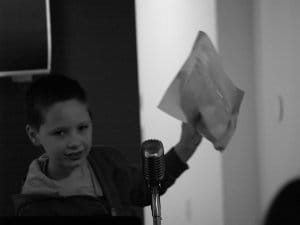
Photo of Bernie at the 2010 Albany WordFest (Photo by Keith J. Spencer)
My son Bernie (age 7) just found out that his poem “Dance To The Chocolate” won in his age group in the Fair Trade Delmar Chocolate Poetry Contest. He gets a prize, gets to read at the award ceremony, and gets his poem printed in the paper. It’s a good month for poetry in the Crane house. Here’s his winning poem:
Dance To The Chocolate
Dance to the music right?
Wrong! Dance to the chocolate
Dance to the chocolate
Dance to the chooooooocolate
Yay!!!
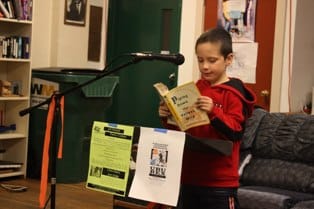
Bernie reading at Third Thursday Poetry Night in December 2009. Photo by Dan Wilcox.
My 7-year-old son Bernie has been writing poems for the past year or so. Today he submitted his first poems and tonight he’s attending his second open mic at the 2010 Albany WordFest. I’m so proud of him and I’d like to share some of his work with you.
The first four poems were inspired by a contest being run by Fair Trade Delmar, an advocacy group in a small town near Albany. They’re looking for kids to write poems about chocolate. The prizes will involve chocolate and the winners will also be printed in the town paper. Here’s Bernie’s suite of poems for the contest.
Chocolate Poems
Chocolate
Chocolate chocolate chocolate
Chocolate is all I can say
Dance To The Chocolate
Dance to the music right?
Wrong! Dance to the chocolate
Dance to the chocolate
Dance to the chooooooocolate
Yay!!!
Chocolate Catastrophe
I love chocolate I’d eat
It day and night but
When you find them really
Take a big bite.
You Love It Too
You love chocolate too
Don’t you? Well if not
START LIKING
IT NOW!! Well eat
It now. I guess it’s either
Now or never.
* * *
And here are two more short pieces, the first of which I find both sad and beautiful.
I don’t know why
I don’t know why
I go to school
I don’t know why I eat
I don’t know why I even live
But I do and I know why
I’m me
me me and me
me I love me me you
love me me love me
me play me play me
play games me
from the Berkshire hills
from a yellow-brick building
with a drug store in the bottom
from a mother and a father
who gave me love and madness
from firefighters in a flooded basement
and old men with missing fingers
from the daddy longlegs, north-pointing
and the tobacco-scented southern earth
from industrial towns in upstate New York
and the blue-carpeted van
from this school and this one and this one, too
always new, always being introduced
from the haven of my room and
from dreams of the ocean
from dinosaur bones and long words
and pretty girls with the same first name
from 27 houses and apartments
in too many towns and cities
from first cars and first kisses
and second chances and third strikes
from the Irish and the German
from the 17th-century seafarers
from the town cowherd and
a documentation analyst
from a radio host and a typesetter
and the receptionist at England Brothers
from drunks and crazy women
who shouted at busts of Wagner
from the laundress and the waitress
and the jailed superintendent
from fire-red Mustang convertibles
and tickling under the dining room table
from submarines and Thailand
and the Housatonic River
from scalding sauce and icy water
and bandages and tears
from desert sands and bald tires
and cheese crackers and Wendy’s
from Chapel Hill to Lexington
Amarillo to Tucson
from the foothills to the mountains
to a backyard filled with stones
from a Big Wheel to a bicycle
to too many unknown homes
from the saxophone to the microphone
to the studio to the stage
from Citalopram and therapy
depression, bliss and rage
from messy rooms and folded laundry
from turn that down and crank it up
from countless hours of talking
and countless talking of ours
from Furukawa to Yokohama
from Catholicism to Methodism to
atheism to Buddhism to atheism
from selfishness to fatherhood
from one side to the other
from husband, father, lover, cousin,
uncle, friend and brother
from Main and Church, from Plunkett,
Chad Circle and Knapp Road
from Dodge and Tanque Verde
from Aoba-ku and Glendale
from Raymond Street and Kellie Court
from Lenox, Pittsfield, Lanesborough,
Syracuse, Oklahoma City, Rochester,
Potsdam, Hilton Head, Concord,
and more and more and more
from Kurt Vonnegut and Hunter Thompson
and Douglas Adams and Hayden Carruth
and George Lucas and John Williams
and John William Coltrane and Steve Lacy
and Charles Mingus and Paul Desmond
and Nova and Batman and Walt Whitman
and Donald Hall and Albert Goldbarth
and Allen Ginsberg and Jack Kerouac
from doubt and fear
from courage and confession
from harmony and discord
from humor and illness
from long-dormant and active
from diagnosis and treatment
and from all the same places you’re from
Listen to this poem by pressing the play button above.
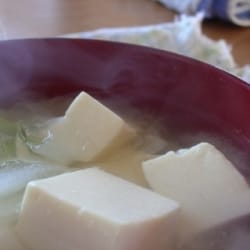
Miso Soup (for Jennifer)
the only thing better than the taste of the sushi
is the lingering aftertaste
mixed with miso shiru and warm ocha
a sensation so rich
it’s almost another meal in itself
I always order one extra piece of unagi
and remember walking into Meiji Jingu
holding your hand
you gave me a book on Zen —
I was into that then —
and I gave you an atlas of our world
so we could choose the next destination
we sat in the kaitenzushi-ya in Shibuya
and watched the endless parade
of plates, daring us
in Nikko, we took a photo in an unexpected
tram car that was right there on the sidewalk
then climbed up all those stairs
to see the sanzaru
there were many little tremors and
the one big one
that had us scurrying for the doorjamb
just as the shaking stopped
and yes, there were cherry blossoms —
there always are —
right outside our bedroom window
and the cleaning man came by each week
and always seemed surprised to see us
we gave him our maple tree
(and you gave me its cousin years later)
I savor these moments and roll them around
on my tongue, heavy with the dusky taste
of shoyu and the tang of vinegar in the rice
Listen to this poem by pressing the play button above.
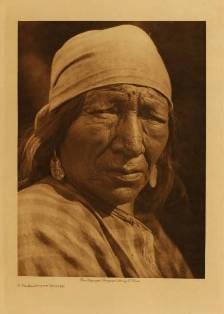
A Blackfoot woman
I am not an Indian
My great-great-great-great grandmother
was a full-blooded Blackfoot Indian.
People say full-blooded not because
they have any proof,
but because it sounds wild, native.
If you do the math, that makes me
1.5% Blackfoot, and not very wild at all.
Say what you will about Ward Churchill;
he was right that all our accomplishments
as a country, all our technology, all our freedom,
all our music and poetry and art and dance and theater,
is being created on land that we stole from people
whose names we don’t even remember.
In college, my roommate’s best friend
paid less for his tuition because he was
above some arbitrary threshold
of Native American ancestry.
Not full-blooded, but bloody enough.
He was generously allowed
to learn quote-history-unquote
in a government building on the very land
his ancestors occupied before they became
little more than discount coupons for the state.
Another branch of my family has lived
in New England since 1638.
We never owned slaves, you’ll hear them
attest proudly, and it appears to be true.
Less lauded is my some-number-of-greats
uncle John Flanders, who served
with distinction in the army of Gen. John Sullivan,
helping to rid upstate New York of the Iroquois.
Sullivan’s troops burned and shot and hung and scattered
the people of many nations, including the Cayuga.
The army destroyed their town of Coreorgonel, and in its place was
established Ithaca, now a haven for higher education and
an oasis for studiers of organic farming and
Native American spirituality.
Living at Coreorgonel were the remnants of the Tutelo people,
who’d been forced from their homes
on the border of West Virginia and Kentucky,
and who were taken in by the Cayugas. It has been
112 years since any human being spoke the Tutelo language.
Sitting on a stage at the Tokyo Film Festival, director Chris Eyre
(of the Cheyenne-Arapaho, remember them?)
was asked by a member of the audience whether he preferred
to be called “Indian” or “Native American.”
“We have so many other problems to deal with
that we don’t have much time to worry about
what we’re called,” he said.
Listen to this poem by pressing the play button above.
Entrances & Exits
Jason Lee Borders entered the world
on a late-summer afternoon in 1973,
sharing his father’s middle and last names
and containing a small flaw in his DNA
that he also shared with his father,
who, unlike Jason Lee Borders,
wasn’t strong enough to resist the genetic revolver.
Instead, he held it to his temple and pulled the trigger,
and a wash of alcohol broke through the levy
and swept the borders away.
Before the little boy drowned,
his mother crept through the window
and ran with him into the night,
gene still intact, waiting.
Jason Lee Gustavson entered the world
in a courtroom in 1979
after the requisite paperwork had been filed;
a new identity, a new life,
another in a long string
of relocations and reorientations.
By this time, even at his tender age,
he’d made one of the few choices
to which he’d remain true,
deciding early on
to leave his father’s revolver tucked in its padded box
in an unlocked drawer of the old oak dresser.
As it turned out, though,
his father wasn’t the only parent with a gift,
and generations of overflowing bathtubs
in the brains of his maternal ancestors
were slowly leaking through his own skull,
surrounding his spongy gray being
with a dark fluid that obscured light and memory.
Jason David Crane entered the world
at a kitchen table with his grandparents
in 1994 after a late-night session of salsa music.
They’d gone through all the family names
when his grandfather suggested the family
for whom an aunt had washed the laundry.
As a gesture to the father
whose name he was leaving behind,
Lee became David
and he became a man.
Jason-Lee-David-Borders-Gustavson-Crane
entered the world and left the world and
entered the world and left the world and
entered the world. His bathtub overflowed
and he sank beneath the water,
one hand clutching the smooth porcelain side.
A poem about seeing my biological father and grandmother for the first time in 30 years.
Sixty-Seven Unopened Videocassettes
Thirty years and fifty percent of my DNA
have brought me to a double-wide with a steep driveway,
tucked away in an enclave of trailers not far from the iron banks of the Ohio River.
She asks me to call her “nanna” because all the children do.
He’s missing most of his teeth — waiting for a new set of dentures.
I have no hook on which to hang this porch conversation,
this three-decade history lesson and game of tag.
So we talk about tobacco farming, long-haul trucking,
and spying on the Russians from within a cigar tube deep beneath the Mediterranean.
I learn about great-uncles and great-aunts and an extra uncle,
only to learn that money and land and other tragedies have driven wedges into this family, too.
I want to walk into the dining room like Antwone Fisher,
but the table is given over to Charlie Brown and Linus —
Christmas decorations awaiting transfer to their holiday destination.
There are sixty-seven unopened Star Trek videocassettes,
a bathroom crammed with history books,
lighters from the Navy,
a robe almost like the one I wear,
and an old shaving cup with a worn brush.
No matter what happens, I’ve erased the most terrible vision —
awaiting the end with the moisture of regret dampening my cheeks.
“The next time you come, darlin’, we’ll have chicken and dumplings.”