A new friend asked me yesterday whether I’m a Buddhist. I always have a hard time answering that question.
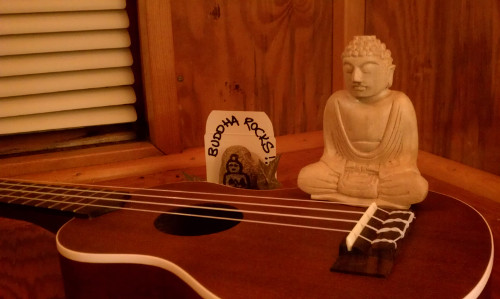
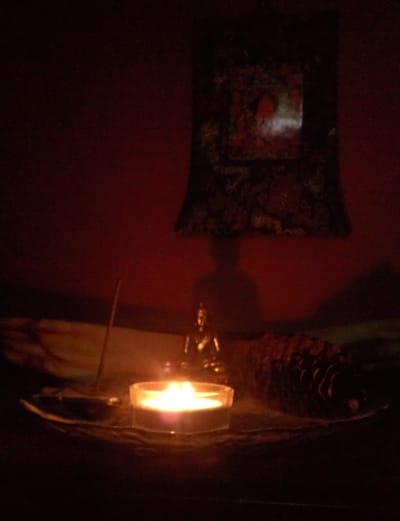
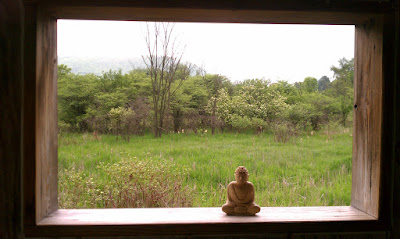
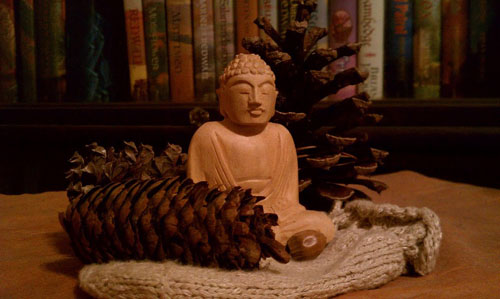
The evidence in favor: I have a daily mediation practice. I meditate in a room with a small shrine that includes a Buddha statue. I read a lot of Buddhist literature. I wear a mala bracelet (although I’m not a Buddhist in the Tibetan tradition; I just wear it as a reminder) and a necklace with an image of the Buddha. I have a copy of the precepts tacked to the wall in my bedroom. When I was on tour last year I carried a Buddha statue with me and took lots of photos of it.
The evidence against: I don’t have a sangha (a group of people with whom I practice). I don’t have a teacher. I don’t belong to any particular sect. I’m an atheist who is reluctant to self-identify with something many folks consider to be a religion.
I should point out that one of the reasons I don’t have a sangha or a teacher is because it’s hard for me to find one of either that fits my needs. I can’t stand the quiet-voiced teachers who populate so many Buddhist centers in the U.S. (Think Bob Ross in robes.) People like that, rather than inspiring equanimity, make me want to punch them. I think that’s why I find Josh Korda from Dharma Punx NYC so refreshing. If I could have any teacher, it would be him. (You can hear him for yourself here.)
And there’s a lot of wealthy white privilege in American Buddhist centers, but, in my experience, not a lot of acknowledgement of that fact or action in the outside world. I’m painting with a broad brush — there are certainly counterexamples. The Buddhist Peace Fellowship, for instance.
But despite all that, I recently updated my Facebook page to read Buddhist Atheist. (I know, I know.) Because for some reason it matters to me to be identified with other people who are walking this same path. Even though “Buddhist” can mean anyone from folks like me all the way to people who believe in demons and spirits and magic and such.
Whenever I write a post like this, I imagine a few of my oldest friends shaking their heads in sadness at my passage to the woowoo side. And some part of me feels the same way — like my need for group identification or membership is a sign that I’m not strong enough on my own.
That usually passes quickly, though, when I think of all the benefits that my practice has brought to my life. Simply put, I’m a better person because of it. I’m able to understand my emotions more fully, to gain a split second of time before I react to something, and to pay closer attention to my world and the people in it.
And there’s something about Buddhism in its basic form that I find very appealing. It speaks to the need to find peace and understanding in my daily life, and provides a way to do that. I’m sure it’s possible to use similar methods without the trappings of thousands of years of Buddhism, but I find them comforting and inspiring.
One of the books that made me more comfortable with Buddhism was Confession of a Buddhist Atheist by Stephen Batchelor. It helped me strip away the things that make me uncomfortable and adopt what, at least for me, is an essential Buddhism. Others might disagree, but Batchelor’s books have been a great help to me.
So yes, I guess I’m a Buddhist. And while that’s not the most affirmative way to put that, it seems like the right way to say it.
/ / /
p.s. — My friend Carmen once said to me, “All I can say is that if you call yourself a Buddhist you aren’t one.” She’s brilliant, but I hope she was wrong.
12 Comments